

Introduction
 The Cottrel/Cottryl/Cotterell/Cotterill family are inextricably linked to the Tudor history of Friar Street in general and Tudor House in particular. We have definitive records of several generations of Cottryls being present dating back as far as the reign of Henry VIII. These extend to beyond the death of Elizabeth I in 1603. They can be placed as living and working on Friar street. This is due to the fact that church records show many of them being in the parish of St Helens plus they pay their taxes in the ward of St Peters. The southern part of Friar street is the only location where the parish of St Helens is included in the ward of St Peters. Friar street was also shorter than it is now in the modern day. Part of Sidbury was tagged onto the end of it when Lich street was demolished in the 1960s.
Note that the spelling of the Cottryl name is not consistent within historical deeds. The same person will have had their surname spelt any number of differing ways. This was dependent on the whim of the person doing the actual writing. We choose to use the spelling Cottryl. This is how one significant Cottryl, Edward, signed himself (i.e. in his own hand) on his will of 1620.
A Tenuous Place to Start
In December 2019 the management of Tudor House Museum, Worcester commissioned a dendrochronology study of the museum buildings. Dendrochronology is:
the technique of dating events, environmental change, and archaeological artefacts by using the characteristic patterns of annual growth rings in timber and tree trunks.
These showed that some of the main structural beams in the half-timbered part of the museum had a felling date of ~1554. Tudor building experts assert that as oak timbers had to be worked whilst still “green” – i.e. without allowing the wood to season (which would be to hard to cut). This then, gives a date range of between 1554 and 1556 for the building of the current structure.
When this date was known it immediately brought to mind the will of John Cottryl. That will was proved in 1556. A tenuous link maybe but one that proved worth following up.
Taxes and Levies
The first record we have for John comes from an entry in the Chamber Order Book dated 14th August 1541. The Chamber Order Book records the doings of the city Corporation – akin to our present day council. In this John Cottryl is charged with making a contribution of 4s 4d to fund two bow men. This he does together with 5 other men of St Peters ward. In the following years of 1541, 1544 and 1546 he is valued for taxation purposes (via something called the Lay Subsidy) within St Peters ward at £10, £10 and £13, respectively.
His purse is further called upon, with others, in 1547 to support two more bowmen. This he does again in 1548. In 1549 he has to provide a “Butts” (archery practise ground) just outside the city Sidbury gate.
Climbing the Corporation Ladder
After these taxation burdens we see John beginning to climb his way up the political ladder of the Tudor city corporation. Perhaps he felt it time to stem flow of the contents of his purse?
His first position is in 1550 when he is sworn in as a “key keeper”. He was one of five trustworthy men who each held one of the keys used to secure the corporation coffers.
Two years later and it was up another notch. In 1552 he was elected as a “searcher of [dyed] cloth”. A searcher was an inspector who imposed quality control on manufactured goods. John must have been the very first person to hold this position in Worcester. It was the cloth-making act of 1552 that first required towns and cities making cloth to appoint someone to examine dyed cloth made there. What is more, no cloth could be sold without the seals attached to the cloth by people like John. The seals would be a sign that the cloth was of the necessary (high) quality demanded.
As cloth was the mainstay of Worcester’s economic wealth it was of vital importance that exacting high standards were maintained. High quality meant that premium prices could be charged for one thing. The searchers could go anywhere that the cloth was held and at any time. All cloth had to be inspected before it could be sold. Only cloth that passed the searchers’ inspection would be allowed to attach the city’s seal. Only cloth with said seal could be sold in the proscribed markets or sent to London for export.
Career High
By 1553 John had made his way on to the “48” – the outer chamber of Worcester’s local government. He would have been thought of as a “capital citizen”. As such he did not really have much power though. The “48” were expected to simply rubber stamp the dictates of the councillors of the inner chamber, the “24”. They were mere figureheads for the more common working tradesman or merchant than the illustrious inner chamber councillors.
It did, however, mean that as a capital citizen his name appeared on the Queen Mary I Charter of 1555. In this, amongst other things, the corporation’s role, function and rights were re-affirmed.
Later that same year he was made one of the two Chamberlains who represented the “48”. As low Chamberlain he would have expected, in due course, to gain admittance to the “24” (if he had not already attained this lofty privilege). Members of the “24” were strictly speaking elected by their fellows but the established route was via the low Chamberlain’s position within the “48”.
Sadly, before he could build on his new found elevated position he died. Who knows how far he would have got had he lived a few years longer. One clause in the 1555 Queen Mary charter directly relates to John as an Alderman. Worcester is granted the right to carry a silver staff before the Aldermen in processions (and a gold mace before the Bailiffs).
Special gowns were worn by the officials so picture John Cottryl in a fine – undoubtedly expensive – trimmed gown solemnly in procession behind a sergeant carrying an impressive silver staff. The corporation would have funded the silverware (from subscriptions no doubt), but John would have had to shell out his own money for the gown.
Last Will and Testament
We now turn to his will which, as ever with such documents, provides a source of personal information sometimes unattainable elsewhere in old documents. This he wrote in 1556, already sick but “hole of mind” – presumably he knew his end was fast approaching. We find out the names of his brother William and sister Elnor (sic) who get land and some cattle, respectively.
We find that he was married and his wife’s name was Issabell (sic). Issabell gets whatever is left of his estate after the specific bequests are made. Unfortunately for us these are not itemised and neither is there a surviving inventory. Inventories, detailed lists of possessions and their value, were quite common accompaniments to wills at the time.
Note that there is no provision for any offspring that John and Issabell might have had. Research has failed to turn up any baptisms from the era that could be attributed to them. So, we could conclude that they did indeed have no children. However, this would be a dangerous assumption to make. It was not uncommon for a parent to omit a child from their will should they have already made provision for them. This could be via the making over of their properties and land to a child, funding their education/apprenticeship or financing them in their chosen profession.
Cousin John
He also names a “cousin”, Jhon (sic) Cottryll, to whom he leaves £20. Care should be taken with the term “cousin” as it was used as a general catch-all for relation. Today the word kin would probably be a more accurate translation. So we should not assume that this second John is a son of John the dyer’s uncle. He may be more distantly related than that, in theory related by marriage (although in this case the common Cottryl surname belies that).
This second John was probably quite pleased with his cash bequest, assuming he was not a dyer by trade himself (we do not believe so).
Backyard Bequest
A startlingly strange item – the second item in the list of bequests – was bequeathed to St Helen’s church:
…all the timber that I bought of the Roodloft in the said church with all that belongeth there unto…
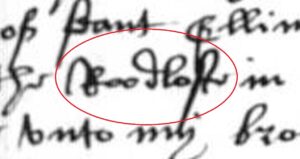
Why did John Cottryl have these timbers? We can only really speculate but the history of that time gives some steers. From the 14th century until the mid-16th century, rood screens and lofts were prominent features of churches in England. These elements, especially the openwork screens, provided artists with an opportunity to create elaborate carvings and paintings. With Henry VIII’s establishment of the Anglican church, it was decreed that the rood and everything above the rood beam be removed. Rood screens were allowed to remain, but thereafter they were more often called chancel screens. Some English rood screens escaped destruction, and some have been restored. NB Late Renaissance church architects preferred an unbroken view into the chancel from the nave. By 1800 the rood screen and loft had become virtually obsolete throughout Europe.
Reformation and Roods
Evidence from other Worcester churches show that the removal of Rood related paraphernalia did not happen immediately. Sadly records for St Helen’s do no survive. It was probably the case that the church wardens hung on to them for as long as they dared. Until eventually succumbing to their destruction when news of the King’s assessors’ arrival became known.
It appears that, ultimately, to prevent their treasures falling into the state’s hands many churches sold them off. In some cases they may have even been taken away by the clergy. There are also accounts of the King’s assessors selling items off rather than destroying them or returning them to London. The parish accounts for St Michael’s show that they paid 15s 2d in 1553 for the removal of their Roodloft there. Interestingly, they paid 20s for three days labour to have the Roodloft taken down in the first place. So they made quite a loss on the deal.
In St Helens, we know that the Rood loft existed in 1519-20 from a few scant pages of the parish accounts that do survive and that they did have “organs”. By 1553, however, their inventory lists no organs at all, from which we may conclude that the Roodloft too had been removed. Note that the Tudors used the plural term organs where we would use just organ (think scissors, trouser etc). St Helen’s did not have multiple such instruments.
The removal of Roods was of course part of the transition from Catholicism to Anglicanism, driven first by Henry VIII and then, with increased fervour, by his son Edward VI.
Shifting Sands
So we can speculate that John the dyer bought the Roodloft timbers during this transition period to prevent them from being taken or despoiled. Rather than using them himself he kept them safe until a time when it would be safe for the church to once again use them. A time safe for him to be known as being sympathetic to such religious devices. The political and religious outlook shifted again, of course, when Mary I took to the throne. It was now “safe” to be outwardly Catholic supporting. None-the-less John does not appear to have been confident enough to return the Roodloft in 1553. He’d seen several shifts in religious doctrines in his lifetime and perhaps expected more. It looks like he “played it safe” only returning them after his own death.
Quatrefoils in the Kitchen
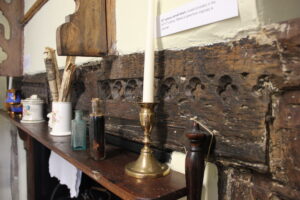
It may be going beyond speculation but there is an intriguing beam in the Tudor House museum Victorian kitchen. This may be one last remnant of the roodloft timbers. The timber is clearly re-used and acts as the sill to the cast-iron cooking range. One end is severely hacked off to make it fit. Along its length are roughly carved quatrefoils. No dating of it has been possible and no documentary evidence found. However, it clearly came from somewhere and quite probably with the carvings already in place. So, maybe it’s one section of the timbers John Cottryl bought from St Helen’s that did not get returned to his parish church?
Religious Beliefs
Another small detail from his will suggests John favoured Rome over an Anglicised church. The highlighted part of following line, located at the beginning of his will, strongly suggests this:
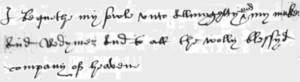
I bequeath my soul unto Almighty God my maker and redeemer…and to all the holy blessed company of heaven…
Including the blessed company of heaven would be something a Catholic would have in their will. At last, in death he feels free to let his true beliefs be known.
Patronage
One final snippet from John’s will comes later on. He makes a bequest to Master (Robert) Yowle, Bailiff of Worcester. He also makes a cash bequest to Sir Thomas Charlemagne, a local priest or preacher. The title sir here does not relate to a knighted peer. It was a common form of address in the Tudor period for people due a degree of respect. Likewise, Master is used to recognise somebody of authority.
Master Yowle, however, gets more material things:

…my great lede and my woodfanths…
A lede is believed to have been a large metal cauldron, woodfanths are woad vats/vessels. Both of which would have been essential tools of the dyer’s trade and of not inconsequential cost.
He seems grateful for the patronage that Bailiff Yowle had shown him during his political career. There is no suggestion of any family relationship between the Cottryls and Yowle.
In Conclusion
Despite the passing of nearly 500 years and there only being 3 real information sources a pleasingly full picture of John Cottryl emerges.
An independent businessman, a master in his craft of dyeing. This trade was not especially prevalent in England at that time and possibly he served only a limited local market. Much of the cloth produced in England was exported undyed as “white” cloth. The general consensus being that continental dyers were more skilled than the English ones. Despite these caveats our John seems to have made a reasonable living as suggested by what he leaves to his family and associates in his will and his acceptance within the local political arena.
An ambitious politician and/or local servant having fulfilled a number of roles within the community. Culminating, of course, with being elected as an Alderman and processing behind the silver staff Queen Mary I allowed the city use of in the 1555 charter.
Pious in his religion, no doubt deeply affected by the upheavals of the reformation. Seemingly, he remained true to pre-reformation beliefs yet shrewd enough not to make this too well known during the latter years of his life. Probably one of a very few men to have in his possession Roodloft timbers in life and at the time of his death.
⋇
Disclaimer
As with many families, now as much as back then, it was very common to use and re-use a first-name across the generations. In the case of the Cottryls they had a penchant for the name John. For this reason it can be very difficult to unpick the life stories of father from his namesake son. Even worse for us, we have found at least 3 generations of Johns, along with associated cousins and nephews etc.
So, in the narrative above there may well be “facts” that have been attributed to the wrong version of John Cottryl. It also possible that one or more of the John Cottryls have had their life stories merged into a single pseudo-Cottryl.
It is for these reasons that the Tudor House Museum research team adopt the motto – nullius in verba – the meaning of which we paraphrase as being don’t take our word for it!